Opinion: Is Urdu language dying because of Hindi infiltration?

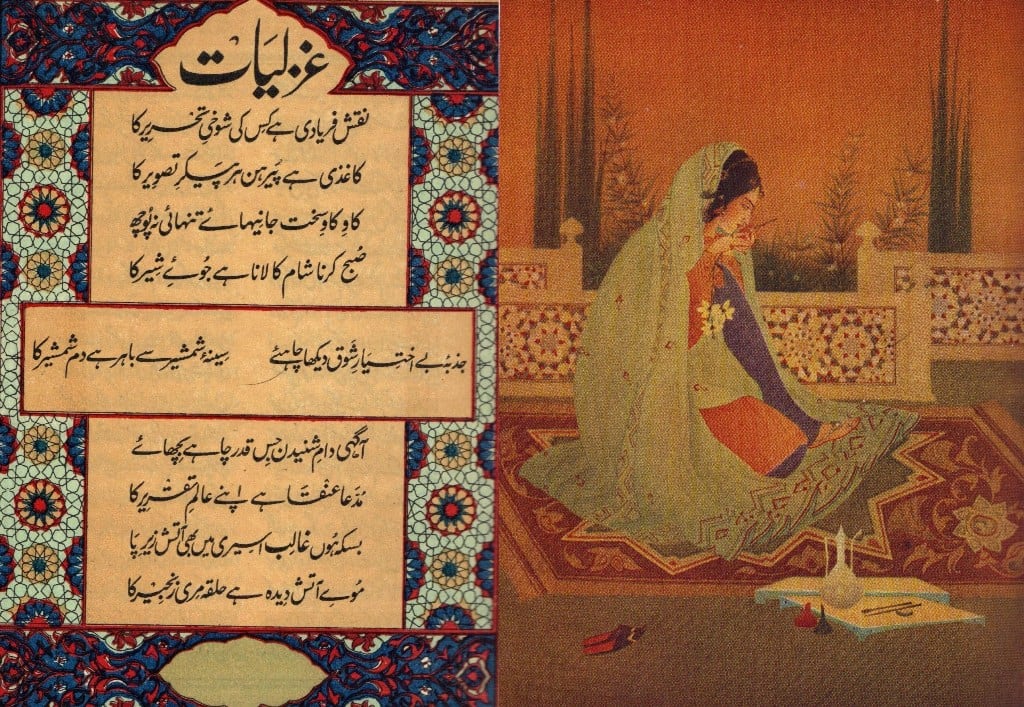
Mirza Ghalib
With the pervasion of Hindi and English words, Urdu seems to have lost its originality, purity and thus the importance.
Sir Muhammad Iqbal - Tere sheeshe mein ma’i baaqi nahi hai, bataa kya tu mera saaqi nahi hai (Your wine-glass contains the life-giving wine no more. Tell me, are you not my sustainer?)
Ammi, apa, bitiya, bibi, ninni bibi, chanda-mama, babua, adaab.
Well, these are some of the first words that begin to echo when I enter the word “mother tongue” on the computer of my mind. A sweet, rosy scent wafts into my mind with some tenderness, some do’s and don’ts gently mixed with it. A sweet and melodious language indeed is my mother tongue – Urdu. Some of the words remain, hanging in there, but some are lost, or at least their meanings and resonances are lost to a fast-moving, polarised and unthinking, self-obsessed world. Those, that hang in there, do much to groom our personalities, perhaps even instill some poetry, along with style and elegance into us. But that does not go to say that you can’t swear or abuse or crack vulgar jokes in Urdu. In fact, they lace the humour or the candidness of such exchanges with a sarcasm which could not otherwise be achieved in a short-cut type, unthoughtful or crude language.
Now, “bitiya” is a typical word for a girl, and can be used for both a little, as well as a grown-up girl, and must be familiar to the reader. But “bibi” is a word which is almost always confused with “biwi” now and I bite my nails anxiously when my father reciprocates my friends’ salaams or namaste with a “khush raho bibi” (meaning stay well and happy young lady), hoping that she understands that he is calling her “bibi” which means a decent or fair lady or young woman and so on. How can he not use the word “bibi” if he wants to retain the flavour of the speech he uses to attend young ladies? He can’t possibly abandon its use just because it gets distorted or misunderstood.
I suppose that is the way to fight the battle against misreading or distortion of many of the words of Urdu language. You should just continue to use them, not with any vindictive agenda, but because you like to believe that correct usage will provide the healing touch to a beleaguered language.
Why do I call my mother tongue beleaguered? In a world of text messages and Instagram, any language may find itself beleaguered when it comes to short forms or acronyms, but the internet and the cell phone has added to the usage of words too. The world is yapping in Urdu too. There are words everywhere, playing hide and seek with language.
So what does Urdu suffer from? What are the challenges it faces today?
With the declaration of Hindi (which could be called a Sanskritised form of Urdu in the Nagri script) as the national language of India at the time of independence, the notion that Urdu could no longer provide jobs caught on very quickly and wrongly. As a result, there were no worthy takers of the language in the university departments. Same was the case with the Persian departments in Indian universities. Very soon, we began producing mediocre or even poor quality Urdu teachers who were themselves slightly embarrassed at having studied Urdu because the syllabi in the universities also suggested to some extent that Urdu was an outdated language whose days of glory were over. The moment of victory was already lost. These mediocre teachers produced even more mediocre Urdu intellectuals which in turn impoverished the Urdu scene.
So, while the Indian nation was never really averse to Urdu, the mentor, keepers, and the Urdu minds had started becoming sterile and polluted, almost as if, ashamed of their legacy of Urdu since they couldn’t see beyond their noses.
Today, we have a huge dearth of good teachers and thinkers in Urdu. Indians, and prominently Hindus, want to learn the language, savour it, enjoy it, but they don’t know where to go. This is a challenge that all, who love their mother tongue Urdu, have to rise to. By assigning Urdu language learning to the madrasas and not teaching it to our own children, we have handed Urdu to the poorest among the Muslims. More than 90% of those children go to madrasas who can afford no better education. This also leads to linking Urdu with religion, and alif for Allah, instead of maybe alif for amrud became a done thing.
My mother tongue tastes like the sweet spring of my mother’s milk as she would lull me to sleep at her breast, melodiously singing “ninni bi ninni bi aya karo, angan mein dhol bajaya karo” (sweet-sounding lady of sleep, come to my courtyard, come and play the drums of sleep sic). You must have guessed by now that “bi” is a shortened and loving version of “bibi”.
This brings me to the question of corruption of language which has become a burning issue, particularly with Urdu. As an official kind of crude and unsympathetic, Hindi blares at us from the television sets and government files and other official sites. It seeps into Urdu, distorting better versions of the language existing there, ruining its elan, its mellifluousness.
I can give you umpteen examples – Sher jaag utha, instead of sher jaag gaya. Chai lijiye, instead of chai pijiye or chai nosh farmaiye, hum Benares se hain, instaed of hum Benares ke hain.
This has echoes of English, which probably got unwittingly translated into Hindi by the Hindi speakers and was then picked up by the Urdu speakers. Also, let us not import words from another language when we already have some in our own language. This runs the risk of bringing the original word into disuse someday in the future. A random list would go like this – towel, specs, table, kitchen, shoes, book, air, and the list goes on.
By the way, do you know the originals?
(Disclaimer: The opinions expressed above are the personal views of the author and do not reflect the views of ZMCL)