Opinion: Economy, energy, education are 3 pillars of Indo-Canadian relationship

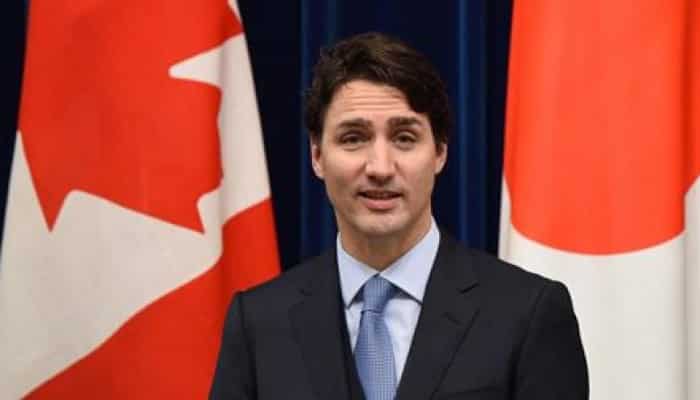
Justin Trudeau
Cooperation in Economic, Energy and Educational sectors are emerging as the 3 key elements or the 3Es of India Canada engagement.
Canada is a blessed nation with stunning geographical beauty, abundant natural resources, huge territory, scanty population, remarkable ethnic and linguistic diversity and wonderful people. But for its extreme weather, Canada would have been the most habitable nation on the planet.
Indians started trickling into Canada in the late 19th century and currently comprise over 3.6 percent of her population. Industrious, law-abiding, educated and affluent, they have carved out a niche for themselves. Canada prides itself in being a salad-bowl instead of a melting-pot, and Indians constitute a vibrant hue, in the Canadian tapestry.
India and Canada enjoy remarkable synergies including complimentary economies. Both nations are members of G-20. Despite ebbs and flows in the ties for a variety of reasons, a buoyancy has sought to be injected through high-level exchanges in the last decade or so.
Prime Minister Modi paid a highly successful visit to Canada in April 2015. He was addressing an audience of over 10,000 in Toronto, when a CEO of a leading Canadian conglomerate, with sizeable investments in India, got so swayed by the electrifying atmosphere, that he said to the author, ‘I don’t understand Hindi, but listen, I am buying whatever your Prime Minister is selling!’
It is remarkable that cash-rich Canadian Pension Funds and giants like Brookfield Asset Management, encouraged by the Indian growth story, have invested some CAD 12 to 15 billion (precise figures are difficult to compute) in the last 3 to 4 years, in sectors like infrastructure, real estate, renewable energy, financial services, distressed assets, modern logistics facilities and e-commerce. Early conclusion of the Bilateral Investment Promotion and Protection Agreement (BIPPA) which has been under discussion for several years, should spur greater investment in both directions. Indian companies have so far invested some $ 2 billion in Canada in the IT, software, steel and natural resources sectors.
Cooperation in Economic, Energy and Educational sectors are emerging as the 3 key elements or the 3Es of India Canada engagement. While investments are growing, trade remains sluggish at a mere US$ 6 billion last year, with $ 2 billion in Canada’s favour. The Comprehensive Economic Partnership Agreement (CEPA), under negotiation for a while, should give it a fillip but is nowhere in sight.
Since 2015, we have been sourcing Uranium from Canada regularly. Canada has huge reserves of hydrocarbons but, currently, it is proving uneconomic for India to import or exploit them. Canada also has strengths in renewable energy, an area in which we can step-up collaboration. A number of small and medium size Canadian companies, which have successfully developed clean-tech and green-tech applications are expanding their footprint in India.
Canada is one of the global hubs of vocational and higher education. Of late, Indian students have been making a beeline to the country. Since 2015, India has emerged as the second largest source of international students for Canada. 2017 saw an unprecedented 60% increase in the number of Indian students to a total of 125,000. They pumped-in some CAD 5 billion into the host nation’s economy.
Additional areas in which we can enhance cooperation to mutual benefit include, agri-tech, IT, innovation, S&T, aviation and outer space, infrastructure especially railways, cold-climate warfare, cyber-security, counter-terrorism, intelligence sharing and tourism.
On the flip side there is the Khalistani issue which hangs over the bilateral ties. Goes without saying that getting it out of the way, will go a long way in deepening mutual attraction and trust.
It is in this background that the important 7-day state visit of Prime Minister Justin Trudeau is taking place from 17 to 24 February. He would be accompanied by an impressive official and business delegation, and would be travelling to New Delhi, Mumbai, Ahmedabad, Amritsar and Agra. Several officials, business, public and cultural engagements are being scheduled for the guest who last came to India as a 12-year old, with his father (Prime Minister Pierre Trudeau) in 1983.
PM Trudeau will witness a different India – aspirational and confident – but as welcoming as in 1983, for we accord considerable weightage to our relationship with Canada and stand ready to qualitatively strengthen it.
(Disclaimer: The opinions expressed above are the personal views of the author and do not reflect the views of ZMCL)