Justice Sanjiv Khanna succeeds DY Chandrachud, takes oath as 51st Chief Justice of India

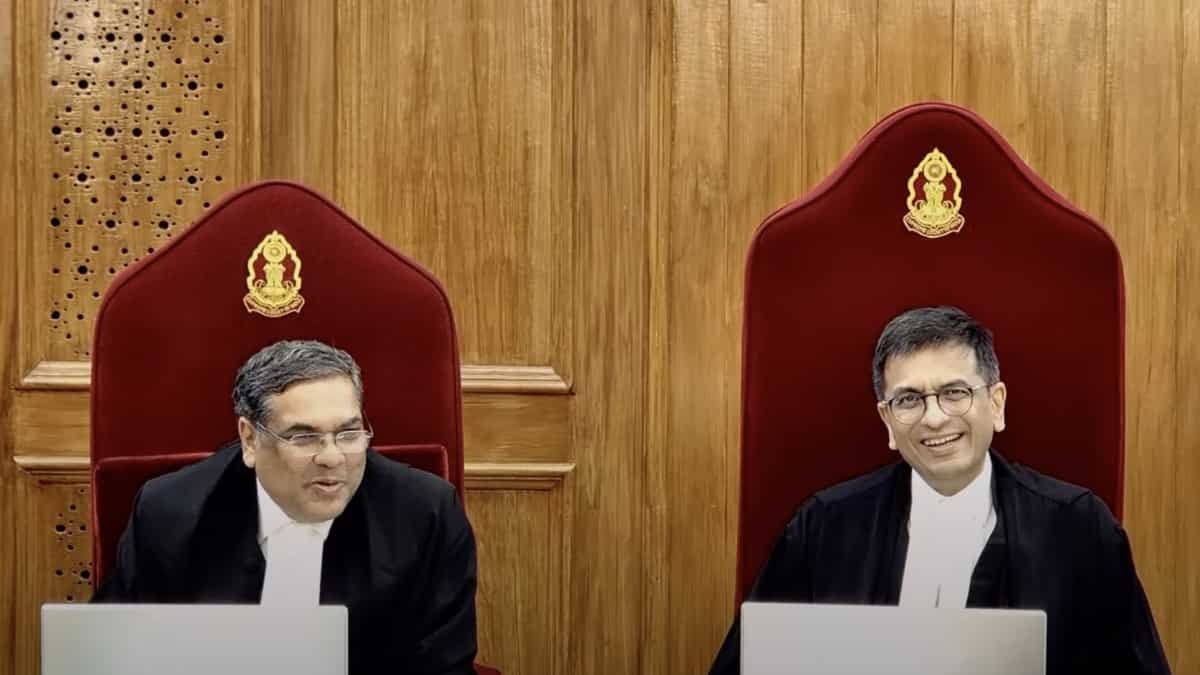
Justices Sanjiv Khanna and DY Chandrachud
Justice Sanjiv Khanna swears in as the 51st Chief Justice of India (CJI) on Monday in an official ceremony presided over by President Droupadi Murmu at Rashtrapati Bhavan. Justice Khanna succeeds Justice DY Chandrachud, who retired on November 10 after a distinguished two-year tenure.
The Union government announced Justice Khanna’s appointment on October 24, a week after Justice Chandrachud formally recommended him as his successor, as per the constitutional norms.
On his last working day as CJI on Friday (Nov8), Justice Chandrachud was given a rousing farewell by judges, lawyers and staff of the apex court and the high courts.
Justice Khanna, 64, is the son of former Delhi High Court judge, Justice Dev Raj Khanna and the nephew of prominent former Supreme Court judge H R Khanna.
He will serve a tenure of only a little over six months before he retires on 13 May 2025, as all judges of the Supreme Court retire by the age of 65.
Prime Minister Narendra Modi was also present at the oath-taking ceremony and shared a picture with the new CJI on X, congratulating Justice Khanna, "My best wishes for his tenure."
Justice Khanna’s judicial career spans over four decades. He enrolled as an advocate with the Bar Council of Delhi in 1983 and practised at the district courts at the Tis Hazari complex. Later, he went on to practice in the High Court of Delhi and tribunals.
He also served as the Senior Standing Counsel for the Income Tax Department and became the Standing Counsel (Civil) for the National Capital Territory of Delhi in 2004.
On 18 January 2019, Justice Khanna was elevated to a Judge of the Supreme Court, even before becoming a Chief Justice of any High Court.
Throughout his tenure at the Supreme Court, Justice Khanna has delivered landmark judgments that have reshaped the legal landscape.
His recent decision on the constitutionality of the electoral bond scheme emphasized transparency in political funding, underscoring the rights of voters to know the sources of funding in elections.
He was also part of the bench that upheld the 2019 abrogation of Article 370, affirming the integration of Jammu and Kashmir with India.
(With inputs from agencies)