
&imwidth=800&imheight=600&format=webp&quality=medium "ISRO supports development of India's deep ocean capsule")
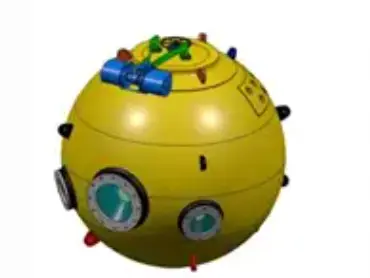
Just like the Indian Government's space mission Gaganyaan aims to develop technology to send its astronauts to earth orbit and return them safely, the Samudrayaan mission aims to develop technology to send a crewed capsule 6kms (6,000meters) beneath the ocean. While the Gaganyaan human spaceflight mission is entirely the Indian Space agency ISRO's domain, ISRO is using its design, engineering, and materials expertise to contribute towards the Earth Sciences Ministry's Samudrayaan, which aims to travel deep into the ocean. ISRO's contribution includes the development and testing of Matsya-6000, a submersible spherical vessel that is meant to execute Samudrayaan.
The Chennai-based National Institute of Ocean Technology (NIOT) and ISRO had signed a Memorandum of Understanding with Vikram Sarabhai Space Centre (VSSC), ISRO for designing and fabricating the spherical vessel Matsya-6000. A sphere of 2.26 meters diameter with a wall thickness of 0.8meters, Matysa-6000 is made out of Titanium alloy (Ti6Al4V - ELI grade) and is expected to withstand an external pressure up to 600bar, under low temperature conditions of -3°C.
This has the capability to carry a three-member crew into the deep ocean. For context, 1 bar is the standard atmospheric pressure felt at sea level, whereas Matsya-6000 is supposed to withstand 600-times as much. According to ISRO, the major challenge in fabricating the spherical vessel is the development of reliable, high penetration (80-102mm thick) Electron Beam Welding (EBW) process and the high-energy (7.5MeV) X-ray radiography facility for the Non-Destructive Evaluation (NDE), which is essential for the certification of the human-rated product.

ISRO's Liquid Propulsion Systems Centre (LPSC) was responsible for developing the process and infrastructure for the welding process and Non-Destructive Evaluation. LPSC-Bengaluru had the facility and expertise to carry out welding up to 20mm thick. To meet the high power demand for welding, the Electron Beam Welding machine was augmented from 15kW to 40kW rating along with additional facilities for chemical cleaning and handling equipment for the higher size and mass.
For Non-Destructive Evaluation, the existing X-ray facility in kV range was augmented to 7.5MeV range. Multiple NDE techniques were employed which complement each other in ascertaining weld quality, based on various parameters. Subsequent to the process development and process optimization by ISRO, the first welding on the actual hardware and detailed evaluation have been successfully completed, ISRO said. High penetration welding of 80mm weld scale, thickness over 7100mm length with 32 minutes of weld duration, was carried out for the first time in the country, the space agency added.
