ISRO gears up for 6 launches per year of its largest rocket LVM3

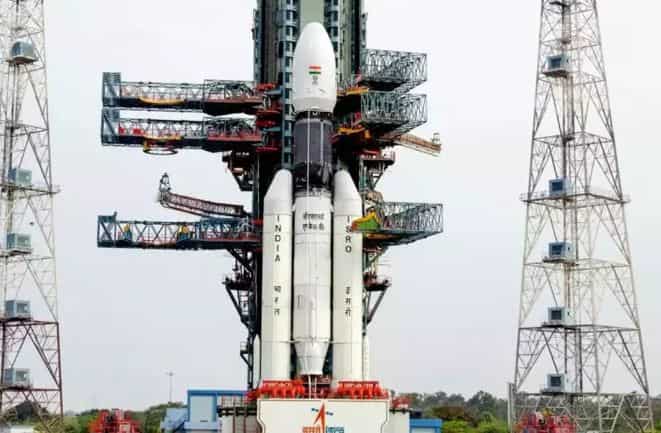
ISRO's LVM3 rocket
The Indian space agency ISRO will soon be able to triple the number of launches of its largest rocket LVM3 - going from a maximum of two LVM3 launches a year, to six launches a year. This is significant, given that ISRO performs just about 10 launches in a calendar year, using its entire existing fleet of four rockets.
The possible increase in launch capability is a result of the Government-run Hindustan Aeronautics Limited (HAL) scaling up its manufacturing facilities that cater large components for the three-stage, 640-tonne rocket, which India uses to launch 4-tonne class communication satellites and commercial missions involving dozens of small satellites that are part of large constellations.
On Wednesday, in Bengaluru, in the presence of top officials from HAL and the space agency, ISRO Chief Dr S. Somanath inaugurated the HAL Aerospace Division facilities that make the fuel tanks and precision components for the LVM3 rocket. HAL will play a larger role in ISRO's future missions and must focus on emerging technologies, designing challenges, and taking up end-to-end tasks to ease pressure on ISRO, he said.
CB Ananthakrishnan, the Chairman and Managing Director of HAL, said that the ongoing collaboration between ISRO and HAL will accelerate India's human spaceflight missions and the development of Next-Generation launch vehicles. "The day is not far off when Space becomes an important vertical of HAL," he added. HAL is predominantly a maker of aircraft and helicopters that are operated by the Indian Armed Forces. HAL is responsible for delivering both Indian-origin military aviation platforms and licence-built foreign ones.
Of the newly inaugurated facilities, the Propellant Tank Production Facility would specialize in the manufacturing of fuel and oxidizer tanks for the LVM3 launch vehicle. These tanks measure 4 metres in diameterand 15 metres in length.
The Computer Numerical Control (CNC) facility houses machines that can handle high-precision fabrication of 4.5-metre rings and fuel tank domes for the LVM3 rocket. It is common for ISRO to source thousands of pieces of rocket hardware from the Indian industry, be it private ones orgovernment-run ones. ISRO has been following this approach to ensure that they can source components faster from the industry and thereby carry out more launches per year.
Taking this further, ISRO is also completely outsourcing the building of rockets to the Indian industry. As part of this, a consortium of L&T and HAL would be entirely building five PSLV rockets and offering them to ISRO in a ready-to-launch condition. In the long run, ISRO hopes to outsource routine activities (building of an existing fleet of rockets) to the industry and use its resources to focus on the core Research and Development work. This approach also offers opportunities for industry and helps establish a space ecosystem in the country and expands the space economy.
