India at UN in 2023: How Delhi's case for reformed UN Security Council is stronger than ever


India's foreign minister Dr S Jaishankar at United Nations General Assembly on Sept 27, 2023
The case for a reformed UN Security Council is on the agenda of United Nations General Assembly (UNGA) since 1993. But 2023 held distinction as India relentlessly utilised its diplomatic capital in and out of the UN Secretariat building in the New York City to expand its initiative of reformed multilateralism. It was also the year when New Delhi held the presidency of Group of 20 nations, the grouping of world's wealthiest economies.
New Delhi led by example.
Right at the start of the inaugural session of the G20 summit in September, Prime Minister Narendra Modi hammered the gavel and embraced African Union's chairperson Moussa Faki Mahamat into the fold of G20.
With African Union's inclusion into G20, India is credited to have revamped the forum of the world's wealthiest economies with the idea of reformed and inclusive multilateralism that successive governments in New Delhi and their representatives at UN headquarters in New York long advocated.
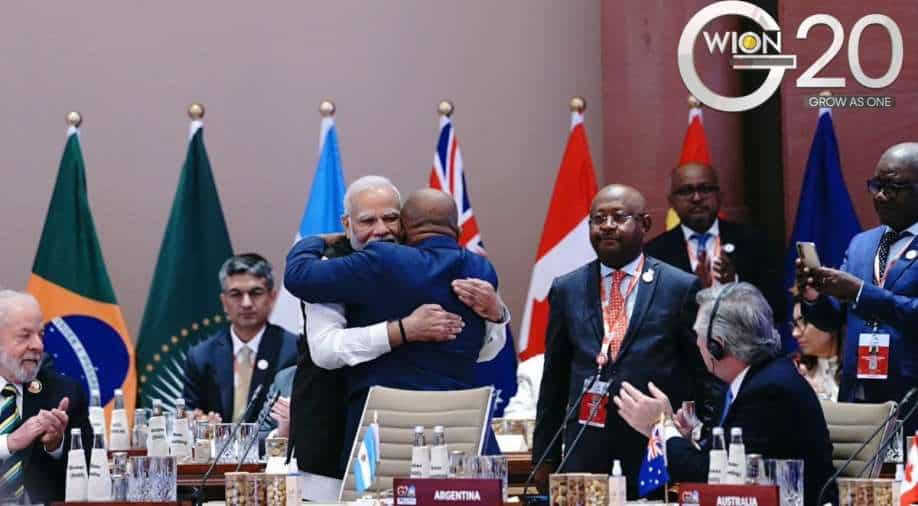
India's Prime Minister Narendra Modi embraced the African Union chairperson Moussa Faki Mahamat at Bharat Mandapam in New Delhi as the 55-nation bloc became a permanent member of G20 | X/@narendramodi
"Just as India has actively supported the idea of bringing AU into G20, the world will some day soon recognise that India and Africa's representative states should also be included in the UN Security Council," Rajiv Bhatia, a former Indian ambassador and Distinguished Fellow at Mumbai-based Gateway House, had told WION on September 9.
A week before the New Delhi G20 summit, Prime Minister Modi, in an interview on September 3rd, reiterated Delhi's position on reformed multilateralism and the question of Security Council reforms. "A mid-20th century approach cannot serve the world in the 21st century," Modi said, while referring to the lack of representative character of the UN Security Council, which was first created in 1945 with an aim to prevent a third world war.
The UN Security Council, as a principal organ of the United Nations, has five permanent members (or P5) – UK, China, USA, Russia and France – and 10 non-permanent elected members (E10), who are elected through the two-thirds majority in the UN General Assembly, in line with geographical distribution by region. The P5 hold the right to disprove the passage of any resolution or decision of the Council.
On September 5, Ruchira Kamboj, India's Permanent Representative to the United Nations launched one of the most impassioned verbal offensives of the year against the exclusive nature of UN Security Council during an open debate on its working methods.
On the collective approach of P5 to ensure its wishes are adhered to by the ten elected members of the Security Council, Kamboj said, "reflects a continuation of the mindset of the post 1945 era: to the victors belong the spoils."
"This is simply unacceptable," she added.
But was it all noise and no substance?
The fact remains that since 2008, the exact process of UN Security Council Reforms — Intergovernmental Negotiations — occur in the informal plenary of a session of the UN General Assembly.
By virtue of their "informal" nature, the Inter-Governmental Negotiations do not have any draft text on the table to negotiate.
The diplomatic calendar next year is set to revolve around 'The Summit of the Future'. The United Nations has branded it as "a once-in-a-generation opportunity to enhance cooperation on critical challenges and address gaps in global governance, reaffirm existing commitments including to the Sustainable Development Goals (SDGs) and the United Nations Charter, and move towards a reinvigorated multilateral system that is better positioned to positively impact people’s lives."
The reforms for UN Security Council are expected to dominate the showpiece UN summit in 2024, powered by India's aggressive diplomatic efforts for reformed multilateralism during the year of its G20 presidency.
"By advancing the idea of ‘reformed multilateralism’, India has made it a part of the global agenda," Sameer Patil, Deputy Director of Observer Research Foundation in Mumbai, told WION. Patil referred to Joe Biden's address to the United Nations General Assembly (UNGA) on September 21 in which the US President affirmed Washington's support for increasing the number of permanent and non-permanent representatives on the UNSC.
"While earlier, there was reluctance on the part of the P-5 to acknowledge the aspect of UN Security Council reforms; now you see them highlighting the need to undertake such a reform, as evidenced by US President Joe Biden’s statement in September 2023," Patil said.
Along with Japan, Brazil and Germany, India is part of G4 political cooperative alliance. The four countries support each other’s bids for permanent seats in the UN Security Council.
"In the upcoming Summit of the Future, India and other like-minded nations will undoubtedly press for text-based negotiations at the IGN to move the needle," Patil added.