
How India is fortifying LAC in Arunachal Pradesh to counter China's belligerence

LAC
The Line of Actual Control (LAC), a porous border separating India and China, continues to remain a cause of anxiety for New Delhi
The Line of Actual Control (LAC), a porous border separating India and China, continues to remain a cause of anxiety for New Delhi. And the reason for that is differing perceptions of the LAC in both the nations. While India, as always, wants to maintain the status quo along the border, China stakes claim to some of the territories in Arunachal Pradesh on the Indian side.
These differences in perceptions have sharpened in the last few years due to infrastructure build-up by both India and China along the LAC. But the contrast is chilling.
China has developed both civilian and military infrastructure along the LAC, and massively. But the Indian side - though it has created a new Corp of the Indian Army for the Eastern Front - still lacks basic infrastructure like telephone connectivity, roads or railways. The deployment of troops on the LAC from Indian side is dense but infrastructure remains absent. Many civilian areas are in fact unconnected.
China has a railway station just 35km from the LAC. The nearest railway station on the Indian side is 200km away. A proposed railway station may bring down the distance to 150km but it still takes an Indian soldier deployed on the LAC more than 80 hours to reach the nearest railway station.
Both the countries carry out long-range patrols to lay claims to the land. Any long-range patrol can take 20 to 28 days to complete. On an average, any unit on such patrol would cover 90km on foot. Rocks are marked and painted during these patrols. This constant painting and repainting have led to these rocks acquiring an inch thick of the coat.
The stark difference between infrastructure development along the border can be attributed to the harsh weather condition on the Indian side. Many say that the weather on the Indian side is far wetter than on the Chinese side of the Himalayas. The connectivity of east and west bank of the Lohit river (a tributary of the mighty Brahmaputra) is glaring. This problem has military implications. During hostilities, it can lead to troops being boxed in their own areas for long and will make an immediate rush to the spot on the other side next to impossible.
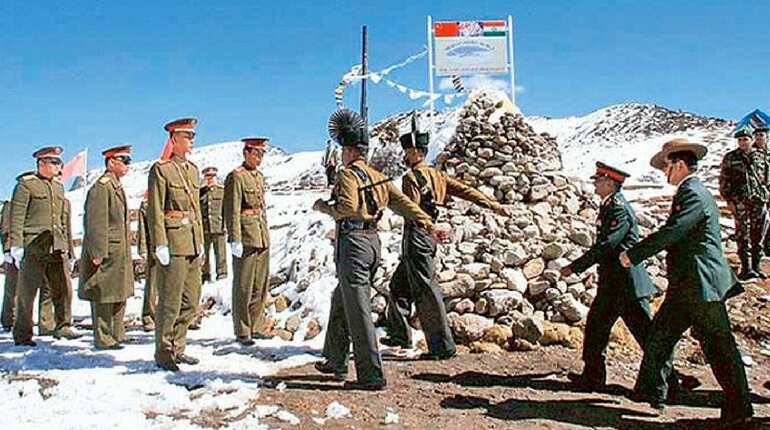
When Indian and Chinese soldiers meet, evolved protocols kick into action, unlike the Line of Control (LoC), or the India-Pakistan border. The areas are designated and only fixed addresses are recorded on camera. Rest of the conversation takes place without it. Unlike eyeball to eyeball stand-off at LoC, the LAC witnesses non-violent stand-offs during patrols.
India also faces another challenge. China has organised scattered communities along the LAC into single villages and built military installations adjoining them. The Indian side, on the other hand, has scattered population, which makes surveillance more difficult.
In Kaho, the last Indian village before the LAC, any Indian phone with international roaming enabled can easily catch Chinese telecom network. This is not the case on the Indian side. The telephone towers of state-run BSNL are 40 to 50km away from the border. It makes intelligence gathering easy for the Chinese as its investment on LAC remains high tech and up to the mark.

But the fact is that this is 2018 and not 1962. The Indian Army is well-deployed and well-stocked to meet any kind of situation. It has set up optical fibre network for its own communication in the border areas. Strong and long bridges have come on the Brahmaputra. Bhupen Hazarika bridge is one such example. It will allow tanks to ply if needed. A 1703-km-long trans-Arunachal Pradesh highway and inter-valley road is in the pipeline. Indian forces will remain more than a match for the Chinese military. According to assessment by the Indian Army, in case of hostilities, the human wave strategy deployed by the Chinese in 1962 will not be repeated. It will be more of shock and awe and missile oriented.
There are no barbed wires on the LAC. There are bunkers and artillery deployed aimed at each other but guns have never boomed after 1962. Both sides intensely and continuously monitor each other and look for red flags. India knows that if Chinese troop movement takes place on the southern loop then it is a red flag and set of military counteraction would kick into force. The Chinese aremonitoring the movement around Sela pass (in Tawang district of Arunachal Pradesh).
The effort remains that the status quo of the border should not be breached. The LAC has been divided into disputed and sensitive areas. The disputed areas are those where both parties acknowledge the difference between position and sensitive where such divergence is not acknowledged at all. The sensitivity remains high and effort remains that local issues should not escalate to diplomatic levels.
Doklam was one such incident when the local face-off got escalated and the matter had to be resolved diplomatically without provoking China. Politically, the matter has become even more sensitive to India after an extension of Xi Jinping's tenure. India's firm response in Doklam was to ensure that status quo is not altered. The deployment of Army on the LAC works on this principle. Even the deployment differs on the Line of Actual Control. In an 803-km-long LAC, deployments depend on the sector. Tawang sector is far more densely deployed than other areas owing to the sensitivity of the situation.
India faces many challenges but opportunities are also immense. Arunachal Pradesh is one area in the Northeast, which is very nationalistic. Hindi unites people in the state. The response to LAC today cannot be a limited to military deployment. It requires a political action and vision. In Doklam it was proved that India will not allow status quo to change. It needs to show the same wisdom and vision inside its own border so that, these areas can be better integrated with the rest of India.