SC decriminalises homosexuality: Google homepage puts up 'gay pride' flag, FB changes DP

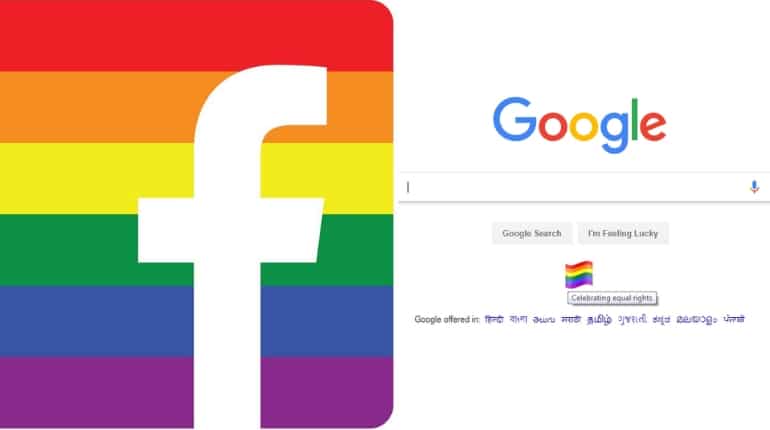
Facebook, Google
The rainbow flag, commonly known as the gay pride flag or LGBT pride flag, is a symbol of lesbian, gay, bisexual and transgender (LGBT) pride and LGBT social movements.
As the Supreme Court decriminialised homosexuality on Thursday in a historic verdict, celebrations erupted across India as supporters of the lesbian, gay, bisexual and transgender (LGBT) community rejoiced in the streets by dancing and waving rainbow flags.
Tech giants like Google and Facebook also marked the celebration of equality and love .
Google India put out a 'rainbow flag' on its homepage with a message reading "celebrating equal rights" popping up when a cursor is moved over it.
The Facebook India page also changed its display picture to a multi-hued icon.
The rainbow flag, commonly known as the gay pride flag or LGBT pride flag, is a symbol of lesbian, gay, bisexual and transgender (LGBT) pride and LGBT social movements.
The apex court unanimously held that consensual sex among adult homosexuals or heterosexuals in private space is not a crime, as it struck down part of a British-era law that criminalised it.
The path-breaking judgement held that Section 377 of the Indian Penal Code that criminalised consensual gay sex was "irrational, indefensible and manifestly arbitrary".
The order was passed — unanimously — by a five-judge constitution bench headed by Chief Justice Dipak Misra, and comprising Justices RF Nariman, AM Khanwilkar, DY Chandrachud and Indu Malhotra.
The 158-year-old colonial-era Section 377 referred to 'unnatural offences' and said whoever voluntarily has carnal intercourse against the order of nature with any man, woman or animal, shall be punished with imprisonment for life, or with imprisonment of either description for a term which may extend to 10 years, and shall also be liable to pay a fine.
The court had earlier reserved its verdict on July 17 after hearing various stakeholders for four days, including gay rights activists.
The country's top court had asserted that courts cannot wait for a "majoritarian government" to decide on enacting, amending or striking down a law if it violates fundamental rights.
It had made clear that it may not strike down the law completely and deal with it to the extent it relates to consensual acts between two adults.
It had said that the other aspects of the penal provision dealing with minors and animals should be allowed to remain in the statute book.