Exclusive: India's INS Shakti and SCI Saraswati to recover ISRO Gaganyaan crew module from sea

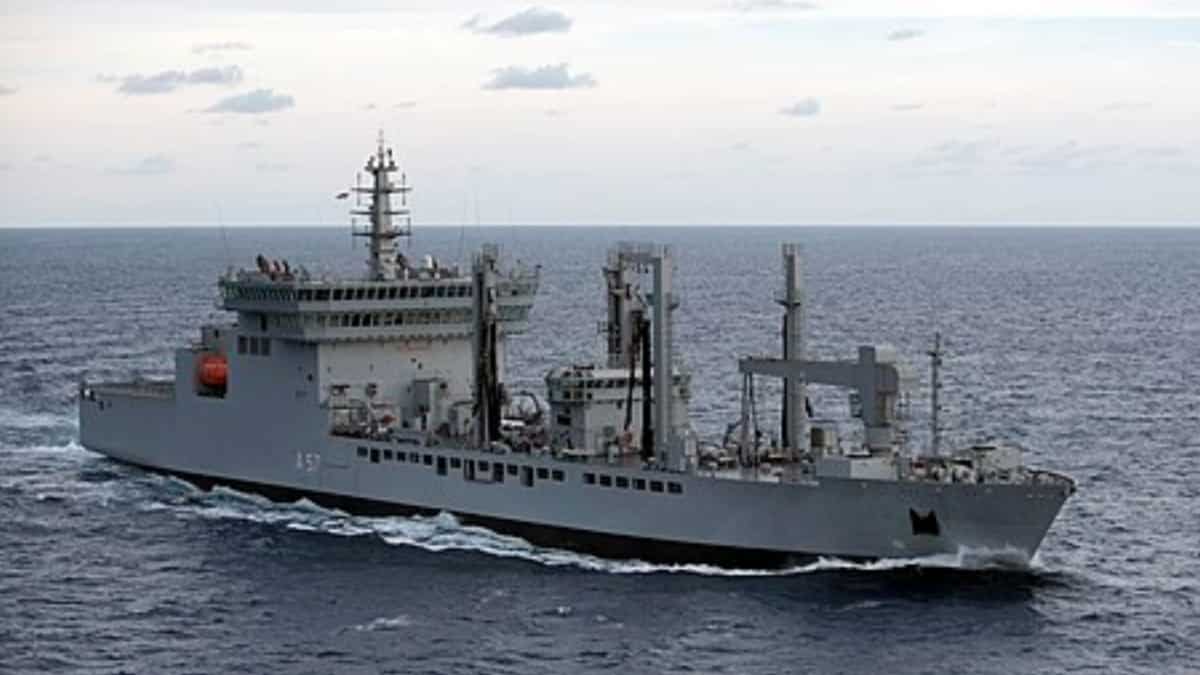
INS Shakti
Around 8:10 am, as ISRO's 'Gaganyaan' crew capsule splashes down in the Bay of Bengal, 10 kilometres off the coast of the Indian Spaceport in Sriharikota, two Indian ships INS Shakti and SCI Saraswati will be waiting at a safe distance to recover the empty capsule, WION has learnt. INS Shakti is a fleet tanker of the Indian Navy and SCI Saraswati is a multi-purpose support vessel (meant to supply offshore installations and serve research purposes) of the Shipping Corporation of India. Both these vessels are tasked with the crucial recovery process of the crew module. Notably, both these vessels are capable of having helicopters on-board, thereby acting as a force multiplier and offering airborne assistance to their respective primary missions.
Recovering the adrift module, lifting it and securing it on the deck of a ship is no easy feat, as the crew module weighs in excess of 4.5 tonnes and this lifting task necessitates heavy-duty shipborne cranes. That's why the Indian Navy and the Shipping Corporation of India have deployed two adequately large vessels for this unique task at sea.

INS Shakti is the Indian Navy's fleet replenishment tanker. Simply put, it is a floating and moving fuel station, grocery store and much more, at sea. When Indian assets at sea require any supplies and replenishment, such massive tankers rendezvous with them and cater to the needs. A unique capability of the INS Shakti is its on-board heavy-duty crane that is capable of lifting loads as heavy as 30 tonnes. Displacing 27,500 tonnes, this vessel is among the largest that are operated by the Indian Navy. Replenishment tankers enable a Navy to conduct missions far from home shores.
ISRO's mission is a very unique one. It is an effort to test the system's required to rescue the astronaut capsule from a rocket that fails mid-flight. This is being carried out in preparation for India's ambitious Human Spaceflight programme 'Gaganyaan'. As part of ISRO's 'TV-D1' test flight, a purpose-built rocket would be launched to an altitude that's a little more than that of passenger airliners. 61 seconds from lift-off, the vehicle would reach an altitude of 11.9 km and a speed of Mach 1.2(1480 kmph) and that's when the rocket would shut down, as pre-programmed.
Immediately, the crew escape system would be triggered and the top portion of the rocket comprising the escape system and the crew module would eject itself higher and farther away from the rocket. They would travel a couple of kilometres higher away from the rocket. 90 seconds after lift-off, at around 17 km altitude, the crew escape system and crew module would separate. While the rocket and the crew escape system free-fall into the sea, the crew module uses multiple parachutes to gradually descend and splashdown, almost 10 km away from the spaceport's shore.
Effectively, three massive aerospace components (each weighing several tonnes) would be splashing down at sea, a few kilometres away from the Indian spaceport. Therefore, both INS Shakti and SCI Saraswati would be positioned far away, at a safe distance. When they get the go-ahead to recover the fallen capsule, they would set sail for the splashdown site of the crew module and deploy their swimmers and divers to secure the floating object and then help the crane do the rest. As there are no berthing facilities in the vicinity of the spaceport, the vessels would have to offload the crew module at the Chennai port, that is less than 80 km from the spaceport.
You can now write for wionews.com and be a part of the community. Share your stories and opinions with us here.
WATCH WION LIVE HERE
