Air quality in Delhi improves to 'very poor' on Diwali, 'severe' today

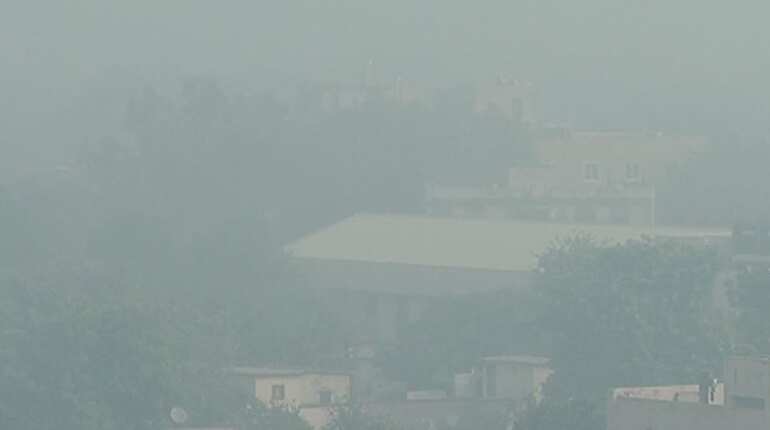
Delhi smog
A 'severe' air pollution level may?affect healthy people and seriously impact those with existing respiratory or cardiovascular diseases
The Supreme Court ban on firecrackers in Delhi seems to have had little effect as evident from the levels of air pollution recorded in the national capital this morning.
The pollution indicator of state-run System of Air Quality Forecasting and Research (SAFAR) turned a deep shade of brown, indicating "severe"air quality in the city, PTI reported.
A "severe" air pollution level mayaffect healthy people and seriously impact those with existing respiratory or cardiovascular diseases.
The Air Quality Index (AQI), a barometer for measuring air pollution, was above 400 in most places in the National Capital Region (NCR). It was at a "hazardous" 978 in New Delhi's RK Puram area today morning.
The US embassy's pollution monitor recorded 'hazardous' air quality with the index scoring an alarming 878, which the mission considers "beyond its air quality index", which ends at 500.
The highest level of AQI, 999, was recorded in the capital's Punjabi Bagh and Anand Vihar areas. The minimum level of pollution, An AQI of 221, was recorded atEast Delhi's Dilshad Garden.
On Diwali yesterday, the AQI improved from "severe" in 2016 to "very poor", the Central Pollution Control Board reported.
The AQI value yesterday in Delhi was 319 (very poor) while it was 431 (severe) in 2016.
A "very poor" air quality implies that people may suffer from respiratory illnesses on prolonged exposure to such air. If the air quality dips further, the AQI will turn "severe".
An AQI level of 0-50 is considered "good", 51-100 "satisfactory", 101-200 "moderate", 201-300 "poor", 301-400 "very poor", and 401 and above is "severe".
The 24-hour rolling average of PM2.5 and PM10, ultrafine particulates which are up to 30 times tinier than the width of a human hair, were 424 and 571 micrograms per cubic metre (ug/m3), much higher than the safe limits of 60 and 100.
The ultrafine particulates are ones which enter the respiratory system and manage to reach the bloodstream, causing health problems.
The Supreme Court had on October 9 banned the sale of firecrackers this Diwali in view of the severe pollution and smog-like conditions prevalent in Delhi last year.
Delhiites, however, defied the ban and the pollution indexes sharply rose from 7 pm, enveloping the national capital in smog.
The situation was better in the NCR which includes Gurugram, Noida and Ghaziabad, where an AQI between 400-420 was recorded today morning.
Crackers were, however,burst in these regions yesterday, raising question marks on the efficacy of the administration in enforcing the top court's ban.
The online indicators of the pollution monitoring stations in the city on Diwali glowed red, indicating a "'very poor" air quality as the volume of PM2.5 and PM10 sharply rose from around 7 pm.
Real-time pollution data was alarming. The Delhi Pollution Control Committee's (DPCC) RK Puram monitoring station recorded PM2.5 and PM10 at 878 and 1,179 micrograms per cubic metre at around 11 pm.
The pollutants peaked after midnight, surpassing the corresponding 24-hour safe limits of 60 and 100 more than 10 times.The monitors stopped working after midnight, suggesting that the pollutants had gone through the roof.
Neighbourhoods reported much lesser noise and smoke till about 6 pm, compared to the previous years.
But as the festivities picked up, the faint echo of crackers started growing louder.
The SAFAR estimated the 24-hour rolling average of PM2.5 and PM10 at 154 and 256 micrograms per cubic metre at around 11 pm, PTI reported.
SAFAR has, however, predicted relatively cleaner post-Diwali air due to favourable meteorological conditions, which are helping prevent the smoke-filled air from the agricultural belt of Haryana and Punjab from entering the national capital.
The Supreme Court-appointed Environment Pollution Prevention and Control Authority (EPCA) is empowered to enforce the Graded Response Action Plan (GRAP) to combat air pollution in Delhi-NCR.
Measures under the GRAP's 'very poor' and 'severe' categories, which include a ban on diesel generator sets, came into effect on October 17 and they will remain in force till March 15.