Delhi, neighbouring cities choke on toxic smog day after Diwali festivities

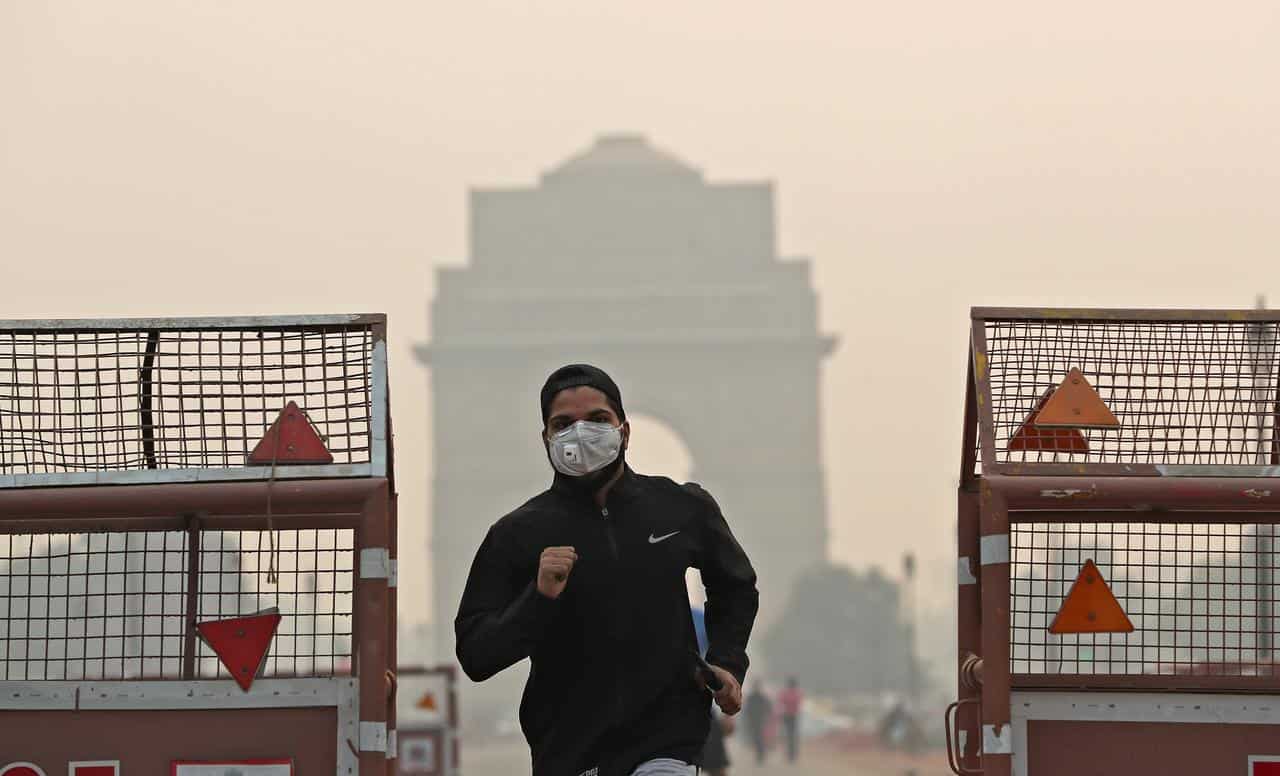
Air pollution, following Diwali, in Delhi
Thousands of Indians in North India, especially the national capital region, woke up on Sunday to toxic air following Diwali, the Hindu festival of lights.
Delhi was blanketed with a thick haze, with the average pollution level in the capital over 9 times what is considered safe by the World Health Organisation.
Revellers on Saturday night defied bans on using firecrackers to celebrate the festival -- imposed by Delhi Chief Minister Arvind Kejriwal.
The NCR's air pollution typically worsens in October and November due to farmers burning agricultural waste -- known as stubble burning -- in adjoining states, along with coal-fired power plants in surrounding states, traffic fumes and windless days.
The air quality had turned "severe" on Saturday evening with stubble burning accounting for 32 per cent of Delhi's PM2.5 pollution, but firecracker emissions and calm winds made the situation even worse.
The raging coronavirus epidemic, with more than 400,000 confirmed cases in the city of 20 million, has also heightened alarm over the health hazard posed by the choking smog, with doctors warning of a sharp increase in respiratory illnesses.
An average of air quality indices measured at different places within the major cities in these states was higher than last year, according to data from the Central Pollution Control Board.
The levels of PM2.5 -- which is about three per cent the diameter of a human hair and can lead to premature deaths from heart and lung diseases -- were 396 microgram per cubic metre ( g/m3) in Delhi-NCR at 6 am, above the emergency threshold of 300 g/m3. The safe limit is 60 g/m3.
PM10 level stood at 543 g/m3 at 6 am, above the emergency threshold of 500 g/m3, according to Central Pollution Control Board (CPCB) data. PM10 levels below 100 g/m3 are considered safe in India.
Delhi Police arrested 10 people and seized 638 kg of firecrackers on Saturday.
The National Green Tribunal (NGT) had on Monday imposed a total ban on sale or use of all kinds of firecrackers in the National Capital Region (NCR) from November 9 midnight to November 30 midnight, saying "celebration by crackers is for happiness and not to celebrate deaths and diseases".
According to the Ministry of Earth Sciences' air quality monitor, SAFAR, the PM2.5 concentration in Delhi on Diwali could have been the lowest in the last four years if there were no fireworks.
The city recorded an overall AQI of 414 at 4 pm on Saturday. It soared to 454 by 10 pm. On Sunday, it stood at 465 at 9 am.
Cities in the states of Punjab, Uttar Pradesh, Haryana, Bihar and New Delhi - which have already been suffering from some of the worst air in the world - saw even higher levels of pollution than on the morning after Diwali last year.
The neighbouring cities of Faridabad (438), Ghaziabad (483), Greater Noida (439), Gurgaon (424) and Noida (466) also recorded their AQI in the severe category.
Delhi recorded a 24-hour average AQI of 337 on Diwali last year (October 27), and 368 and 400 in the next two days. Thereafter, pollution levels remained in the severe category for three days on the trot.
In 2018, the 24-hour average AQI (281) on Diwali was recorded in the poor category. It deteriorated to 390 the next day and remained in the severe category on three consecutive days thereafter.
In 2017, Delhi's 24-hour average AQI on Diwali (October 19) stood at 319. It, however, slipped into the severe zone the next day.
This time, the India Meteorological Department has said that a fresh western disturbance is likely to increase the wind speed and improve the air quality in Delhi-NCR post Diwali (Sunday and Monday).
Light rain is likely on Sunday under the influence of a western disturbance. The air quality is likely to improve due to an expected increase in the wind speed, Kuldeep Srivastava, the head of the IMD's regional forecasting centre, said.
The Air Quality Early Warning System for Delhi also said the situation is likely to improve significantly on Sunday.
Under the influence of a Western Disturbance, isolated rainfall over plains of northwest India and adjoining central India is likely on Sunday. Generally cloudy sky, light rain, thundershowers accompanied with gusty winds (speed 30-40 kmph) is likely towards afternoon-evening on Sunday, the central agency said.