
&imwidth=800&imheight=600&format=webp&quality=medium "At $400mn, India to establish telescopes to enhance astronomical observations")
The Indian Government's plan to enhance and promote Astrophysics and Astronomy would be executed at a cost of ₹3,600cr (approx $400), over a period of five years, said Abhay Karandikar, Secretary of the Department of Science and Technology(DST). This would include the setting up of two all-new ground-based telescopes, the upgradation of an existing ground-based telescope, and the setting up of a state-of-the-art planetarium. All these efforts, which are to be undertaken by the Indian Government's DST, are expected to materialise in five years. Together, these facilities will strengthen cutting-edge research, data dissemination, advanced training, and public outreach, said the Government. Elaborating on the plans, Karandikar said that the National Large Solar Telescope (NLST)
at Merak, Ladakh will provide early access to critical solar data and, in synergy with ISRO's Aditya-L1 sun-observing satellite mission, will generate unique datasets vital for next-generation space-weather forecasting. The NLST is likely to cost between₹800-1,000cr. Aditya-L1 is a satellite that's meant to observe solar weather and related phenomena and is India's first satellite meant for the purpose.
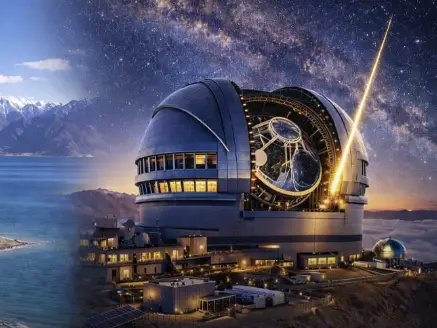
To be located at an altitude of 4,500 meters in the Himalayas, the National Large Optical–Near Infrared Telescope (NLOT) is expected to set new benchmarks for ground-based optical–infrared astronomy. Karandikar said that this would come up at a cost of ₹1,800cr. It would be based at Hanle, Ladakh, under pristine observing conditions.

Further, the Himalayan Chandra Telescope at Hanle, Ladakh, would be upgraded. The telescope is based in a dry, cold desert with a sparse human population, with the ancient Hanle monastery as its nearest neighbour. The cloudless skies and low atmospheric water vapour make it one of the best sites in the world for optical, infrared, sub-millimetre, and millimetre wavelengths. In addition to this, a state-of-the-art 'Cosmos-2' planetarium capable of creating and projecting stunning visuals of the universe, both in real-time and from archival data, would be set up.
