Aditya L-1 launch: India's solar mission lifts off, takes country closer to sun after moon landmark

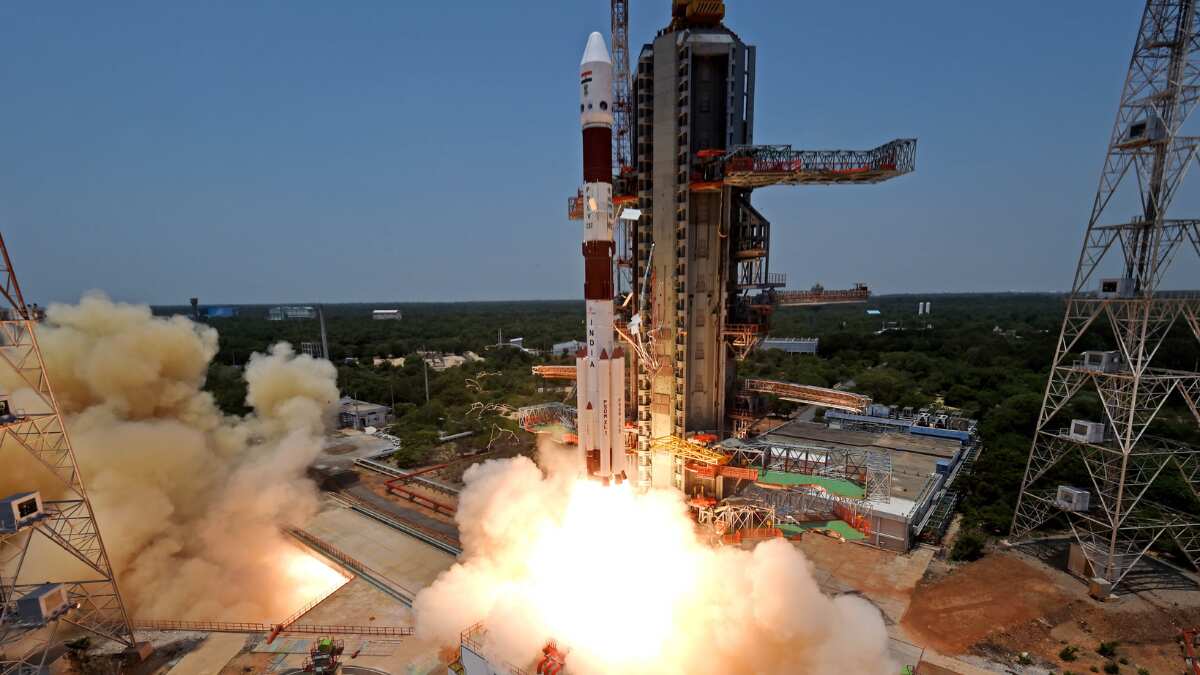
Aditya L-1
Just days after India achieved the first lunar landing near the unexplored south pole of Moon, the Indian Space Research Organisation launched its Aditya-L1 mission successfully to study the Sun at 11:50 am on Saturday from the launchpad at Satish Dhawan Space Centre in Sriharikota.
An hour after the launch, the vehicle placed the satellite precisely into its intended orbit. "India’s first solar observatory has begun its journey to the destination of Sun-Earth L1 point," ISRO announced.
The 1,480 kg spacecraft has been carried by India’s workhorse Polar Satellite Launch Vehicle (PSLV) and took a trajectory for its placement in a highly elliptical orbit of 235 km x 19,500 km around the Earth. The configuration of PSLV has six solid fuel-based boosters.
The orbit as well as the velocity of the spacecraft will be increased till it gets closer to the Sun inthe designated orbit.
The distance of 1.5 million km to the Lagrange Point, named L1,will be covered in nearly four months (125 days).
The spacecraft will then be inserted in a halo orbit around the L1 point where it will stay put because of balancing gravitational forces, thereby reducing fuel consumption for the spacecraft.
Lagrange Pointsare named after Italian-French mathematician Joseph-Louis Lagrange.
Aditya-L1 mission will carry out seven science experiments, and will collect data for the next five years.
The mission has been designed to provide remote observations of the solar corona and record solar winds. The Visible Emission Line Coronagraph (VELC), the primary payload of Aditya L1 will send 1,440 images every day to the ground station for analysis after reaching the intended orbit.
The satellite and its payloads will revolve around the Sun will observe the Sun continuously without any eclipses. This will help observe solar activities and their effect on space weather in real-time.
India has privatised space launches and is looking to open the sector to foreign investment as it targets a five-fold increase in its share of the global launch market within the next decade.
Indian scientists have so far observed the Sun through telescopes on the ground, while relying on the data from solar missions launched by the United States, Europe, the United Kingdom, and Japan.
WATCH WION LIVE HERE
You can now write for wionews.com and be a part of the community. Share your stories and opinions with us here.