Mahalaya: How a 1931 All India Radio programme became a tradition for Bengalis world over

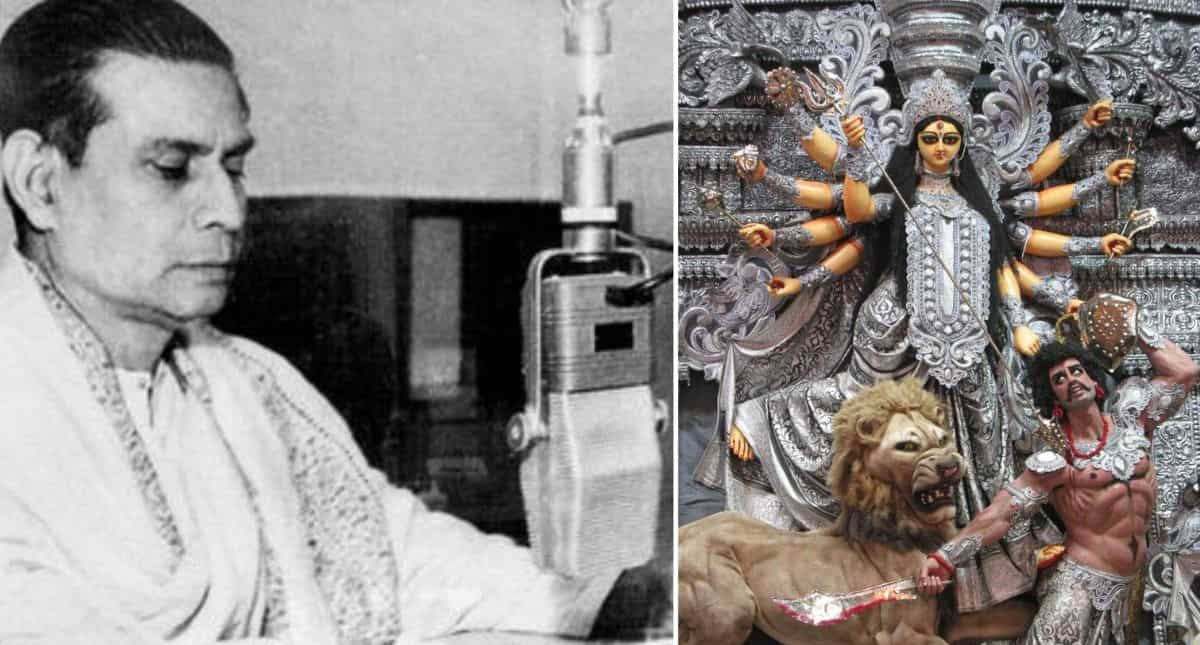
File image of Birendra Krishna Bhadra and idol of goddess Durga
Every year, Hindus mark the end of a 14 days lunar period in the Hindu calendar (known as Pitri Paksha in Sanskrit) with Mahalaya. It is a day to remember one's ancestors and offer food to birds and animals in honour of one's forefathers.
For Bengalis, this day marks the beginning of week-long festivities- popularly known as Durga Puja which overlaps with Navrati, another Hindu festival celebrating the goddess.
On Mahalaya every year, Indian Bengalis wake up in the wee hours of the morning to listen to the legendary radio broadcaster and playwright, the late Birendra Krishna Bhadra's recitation of the Mahisasuramardini. The audio-play which has over the years been adapted in Hindi for pan-India audiences and included in numerous teleplays has become part of a tradition of the Bengali community.
Now available on Youtube, it is almost ceremonial to play Bhadra's audio-musical in the early hours of the morning on Mahalaya. No matter which part of the world one is in, Bengalis are known to tune in to Bhadra's voice and recitation of the Sanskrit shlokas which herald Durga Puja festivities days later.
While it has become a tradition for all Bengalis to mark Mahalaya with Bhadra's voice, it interestingly has its roots in modern-day technology.
It is actually a radio-induced culture - introduced in 1931 as a programme to give devout Hindus company as they made their way to the banks of River Ganga to perform rituals before sunrise. These rituals, known as 'Tarpan', were performed in honour of one's forefathers.
History of Mahisasuramardini- the play
In 1931, Mahalaya the programme was the first broadcast in Akashvani, Calcutta. The programme was organised by Pankaj Kumar Mallik, Premankur Aatorthi, Birendra Krishna Bhadra, Nripendra Krishna Mukhopadhyay and Raichand Boral- considered stalwarts of AIR, Calcutta.
In the initial years, as the radio play gained popularity, the one hour 30 minutes would typically be performed live at the radio station in Calcutta led by Bhadra's recitation. Some of the most prominent singers of Bengal including Dwijen Mukhopadhyay, Pratima Bandopadhyay, Shyamal Mitra, and Hemant Mukherjee have been part of the audio-musical over the years.
The controversy
Bhadra was briefly replaced in 1976 by the voice of prominent Bengali film actor Uttam Kumar and the programme was renamed 'Durga Durgatiharini' but did not get a favourable response from the listeners as they wanted Bhadra's voice for the occasion. Akashvani eventually brought in the original version recited by Bhadra the next year, and it continues to play every year.
Funnily, while most have grown up listening to Bhadra's recitation believing it to be a part of the tradition, it was in fact a modern-day radio-induced tradition that Bengalis made their own. Mahalaya and Bhadra's voices are synonymous with Durga Puja celebrations. The celebrations seem incomplete without listening to Bhadra's booming voice reciting Sanskrit shlokas.
His recitation has been used massively in pop culture in the last 90 years. Bhadra's voice, the classic audio programme is as integral to the festivities as the days of Durga Puja itself.
With the onset of TV, teleplays enacting the story of how Goddess Durga took charge and killed Mahisasura, the devil king, are played on various channels. Each has its own version of the folklore, but the climax, where the actual battle between the goddess and the demon takes place always has Bhadra's recitation playing in the background, no matter which channel you are tuned into.
In the last 90 years, Bhadra has become an important part of Bengali culture. What started as an invocation of the goddess as a means to keep sleepy devotees awake in the early hours of dawn, has over the years become a culture in itself that no Bengali is ready to let go of.

