

&imwidth=800&imheight=600&format=webp&quality=medium "SPOILER ALERT | Is James Gunn's Superman an allegory for Israel-Palestine conflict?")
James Gunn's Superman has deliberately stirred up a political uproar. With opinion over the film's central conflict has drawn attention from fans online. The lead conflict of the film is around Boravia, ethnically white and Jarhanpur, ethnically non-white, where the former has occupied the latter, drawing a simile from real-world politics into the DC universe. Critics and social media posts have strongly drawn the parallel, but Gunn himself refused to give in to the controversy. Critics have praised the film, calling it ‘fresh’, and it sits at 85 per cent on the Tomatometer as of now.
In an interview with the Sunday Times, James Gunn said, “An immigrant that came from other places and populated the country, but for me it is mostly a story that says basic human kindness is a value and is something we have lost…and obviously there will be jerks out there who are just not kind and will take it as offensive just because it is about kindness. But screw them.”
How does Superman resemble the Israel-Palestine conflict?
Boravia is a militarised, technologically advanced state, powerful and well armed. Boravia invades and occupies Jarhanpur, a resource-scarce, impoverished country. Lex Luthor, who has powerful corporate/military interests, backs Boravia's invasion and manipulates the media narratives to frame Boravia as justified. Superman intervenes not as a weapon of war but with moral responsibility to end bloodshed.
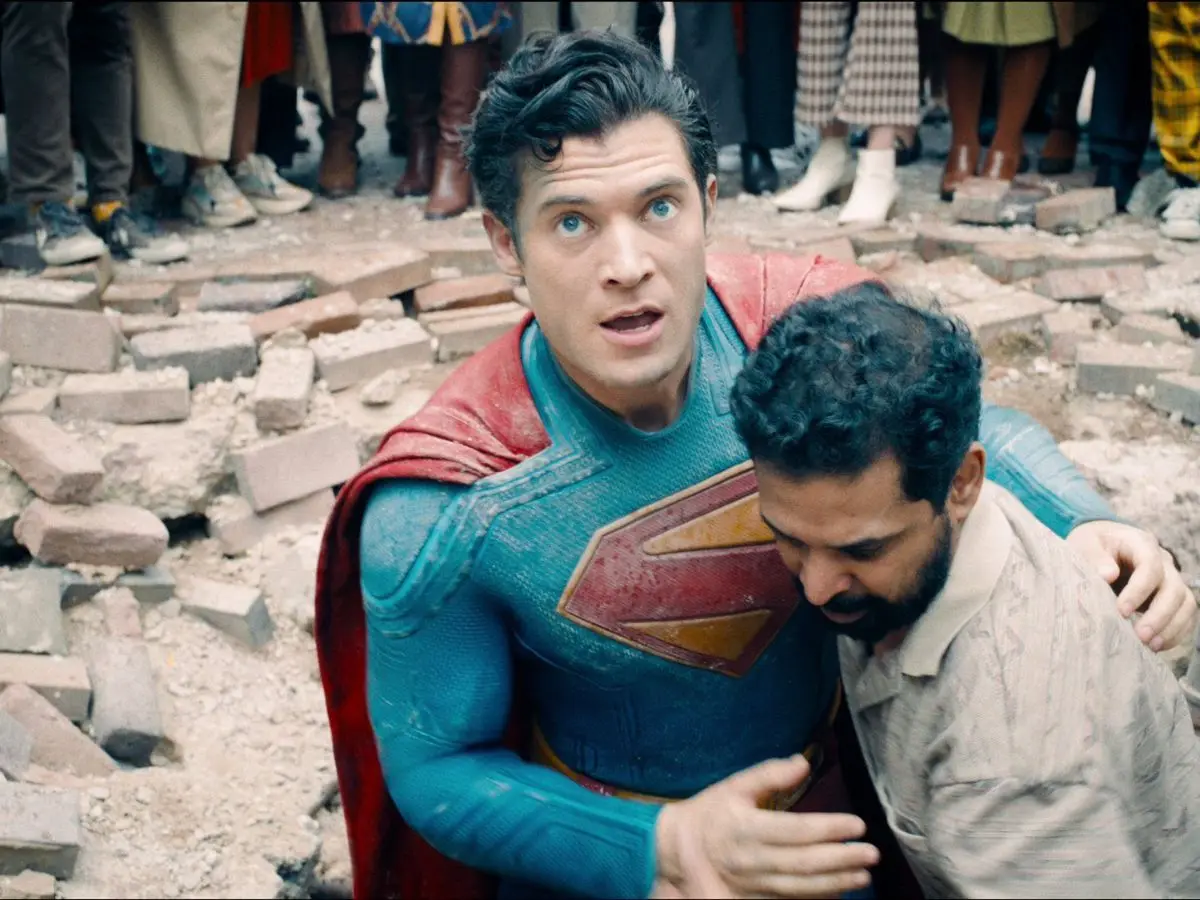
There are certain visual metaphors and metastories which coincide or draw inspiration from the real world imagery, such as drones and missiles raining down on a desert cityscape, and children hiding in rubble. It echoed scenes at Gaza where civilians were caught in collapsing buildings while Superman shielded a family with his cape. The blue-and-grey drones resemble Israeli UAVs like Hermes 900. A massive wall separates the once shared territory and is heavily guarded by armed forces, similar to the Israeli walls at the West Bank. The protest scenes were similar to those of West Bank children throwing stones at the wall. Gunn includes “pocket-dimension prisons” reminiscent of ICE black sites. There was a silent moment where Superman looked at graffiti on a broken part of the wall reading: "Home is not a place. It’s a right."
Even though not a direct commentary on the conflict in the Middle East, but an evocative analogy. As one reviewer explains, “The crux of the film is an evil country in the Middle East filled with white people that has been a US ally for decades, trying to invade a neighbouring country to genocide its people and steal their land”.
How did the US media react?
Fox News presenter called the film a “moat of woke” and joked about the character having MS-13 branded on the cape instead of the iconic S. With MAGA supporters accusing it of pushing down liberal “ideology” with viewers.
Gunn has publicly denied that the Borovia plot is about the Middle East. Casting decisions like the comedian Bassem Yousuf, who had appeared on the Piers Morgan Uncensored, a vocal critic of the occupation, were changed from the film.
Still, the allegorical window remains open, people online poured “I loved Superman… Boravia = Israel, Jarhanpur = Palestine…” “powerful and clear commentary on the senseless genocide against Palestinians in Gaza.”
The irony is not lost, Superman was first created by Jerry Siegel and Joe Shuster, two US children from Jewish immigrant parents.

