Flashback Friday: How the World Economic Forum became the poster boy of globalisation

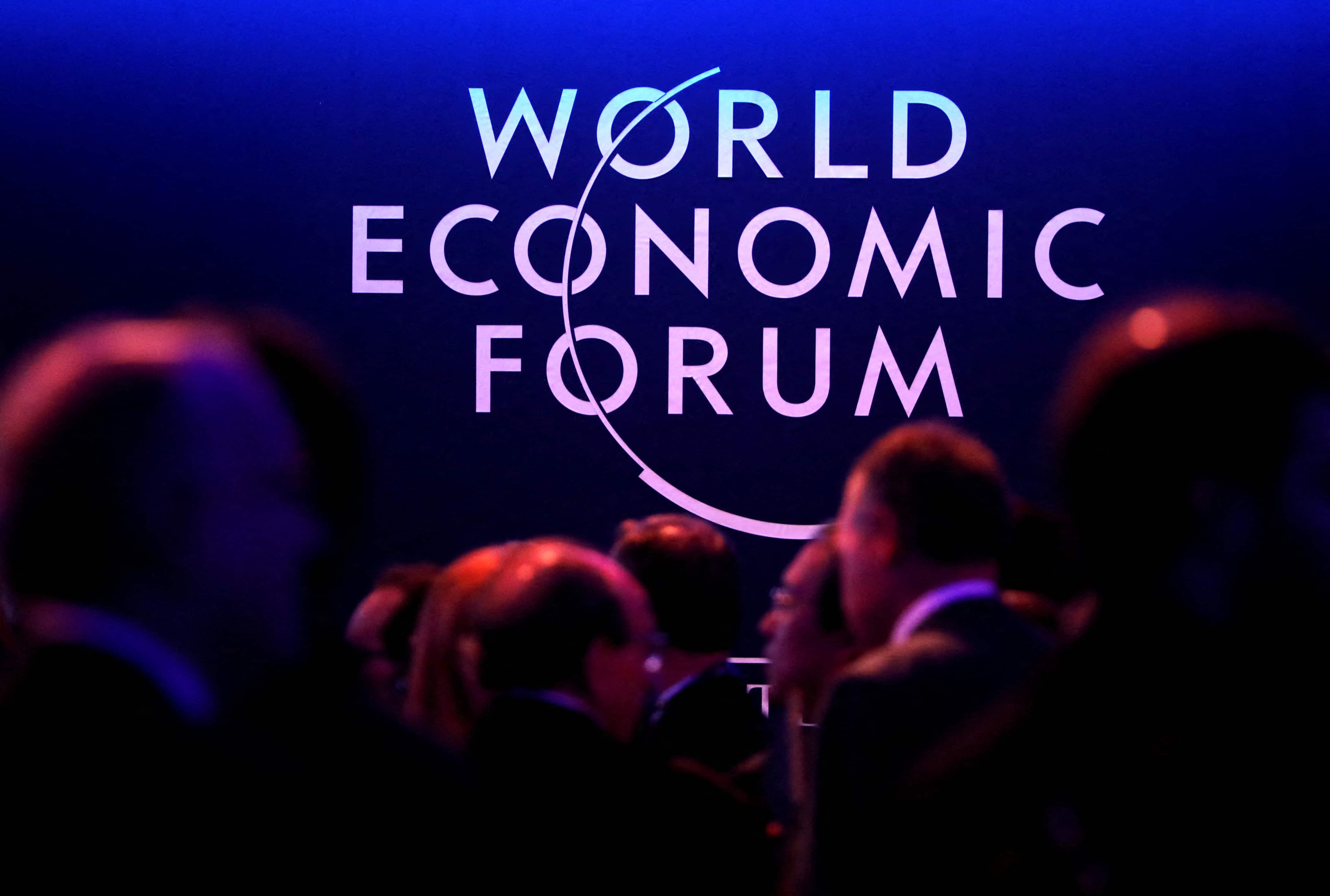
A logo of the World Economic Forum (WEF) is seen as people attend the WEF annual meeting in Davos
Every January, the Swiss resort town of Davos becomes the meeting place of global leaders, industry titans, and thought leaders.
Since 1971, the World Economic Forum (WEF) summit has turned the town's name into a by-word for the 'global elite'.
However, the connotation is often negative.
The World Economic Forum has long been the torchbearer of globalisation, arguing that it brought "millions out of poverty".
It has continued to bat for globalisation, despite the idea coming under attack over the last decade.
In fact, even as the world's economic growth slowed in 2023, the WEF pitched for revamping globalisation.
The driving force behind the Forum's globalisation push is its founder, 85-year-old Klaus Schwab.
The German-born economist and professor of business policy has deemed globalisation “a very easy scapegoat”.
When Schwab began the non-profit organisation in 1971, 'globalisation' was a little-known concept.
While the WEF has now become the poster boy of globalisation, its origins were more European.
The European Management Forum, its earlier avatar, brought together European corporates, who wanted to compete with U.S. firms.
Having studied management in the US, Schwab was fascinated by Americancorporate practices and wanted it replicated in Europe.
Long eclipsed by the US, Europe soughta return to economic glory. Schwab's idea made a mark instantly.
Several hundred top European executives gathered at Davos in January 1971 for a two-week-long symposium.
The idea of a multinational forum was pathbreaking for the 1970s, an era defined by the Cold War.
During the Cold War, the United Nations provided the only common platform for global leaders.
But the geopolitical split between the Capitalist & the Socialist world meant countries rarely agreed on anything.
This is why Davos, a remote location that provides privacy, offered the best platform for divergent views.
At least, that is what the World Economic Forum continues to claim to date.
Schwab's idea of the forum emerged out of the concept of "multi-stakeholder participation".
This approach considers the interests of everybody involved in the production flow and distribution process.
Thus, the owner, shareholders, customers, suppliers, employees as well as the government and interest groups play a role.
Primarily a management concept, Schwab creatively applied it to build the forum, where he brought companies and policymakers together.
But its transformation from a European organisation that put out feelers to the US to a globalisation poster boy was completeby the mid-1980s.
By then, the non-profit organisation got its present name, more trans-Atlantic voices spoke at Davos, and a rising China made its debut.
In fact, Henry Kissinger remarked at the 1980 Davos meeting: "For the first time in history, foreign policy is truly global."
When the Soviet Union dissolved in 1991, it was seen as a win for the democratic, free-market world.
The world became unipolar, with the West-led world order facing no major challenge.
This also meant that WEF was in pole position to expand its idea of globalisation to newer markets.
Globalisation became the buzzword of the 1990s and early 2000s, as the economies of India and China rose rapidly.
Many even attributed the establishment of the WTO to several discussions that took place at Davos summits.
It seemed WEF's motto "Entrepreneurship in the global public interest" was reshaping the new economic order.
The 2008 Global Financial Crisis, however, disrupted the WEF's fairytale-like rise.
As economies collapsed, people began questioning the neo-liberal globalisation that WEF was closely linked to.
Populism rose sharply as those apparently left behind by globalisation emerged as a political force.
As globalisation came under attack, so did its poster boy - the World Economic Forum.
Once a melting pot of ideas, Davos began to be identified as a 'talking shop' of the global elite with minimal real impact.
In fact, many have raised questions about the true intentions of the forum.
Critics have argued it promotes multinational firms and its version of global capitalism under the pretext of "doing good".
Even Schwab has agreed that globalisation in its current form may no longer work, advocating for 'Globalisation 4.0'.
Schwab has left a mark in the annals of global political economy. But only posterity will tell us whether his legacy transcends the WEF.