Bank of Korea expected to maintain interest rates amid political shifts, inflation concerns

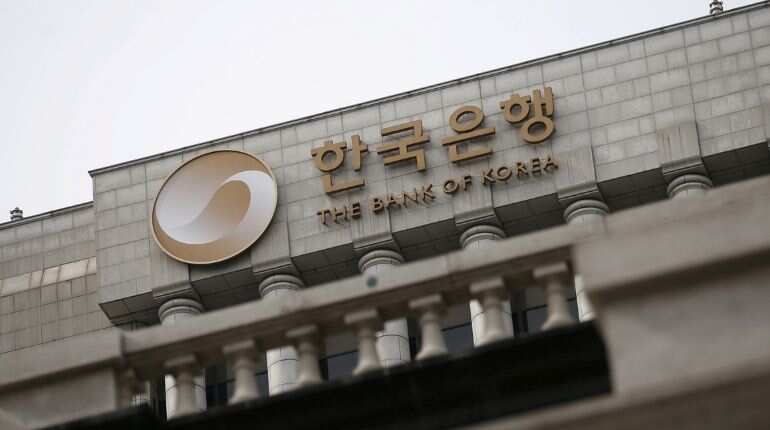
Bank of Korea
The Bank of Korea (BOK) is anticipated to maintain its policy rate at 3.5 per cent in its forthcoming meeting on Friday.
According to Bloomberg, this decision comes as South Korea experiences a political shift and as two of the bank's board members prepare to step down.
All 23 economists surveyed by Bloomberg are in consensus that the central bank will keep its benchmark rate unchanged, indicating a cautious approach towards policy adjustments.
The BOK last raised its rates in January 2023 and has since maintained a "restrictive" rate level to combat inflation.
Inflation emerged as a major issue during Wednesday's parliamentary election.
Despite the government's efforts to mitigate inflation through various initiatives, including encouraging retailers to reduce grocery prices and temporarily freezing public utility charges, President Yoon Suk Yeol's party suffered a major defeat.
Last month, consumer prices surged by 3.1 per cent, surpassing expectations and remaining above the BOK's target of 2 per cent.
Additionally, the looming concern of escalating household debt adds to the BOK's hesitancy in announcing an early policy shift.
Bloomberg cited Kim Sung-soo, an analyst at Investment & Securities, who advised caution, saying, “Inflation is showing the last mile is not easy.”
This sentiment is reverberated by the rise in South Korea’s three-year bond yield, which has increased by approximately 24 basis points this year to 3.39 per cent, nearing the BOK's current rate.
Market indicators, such as the swaps market, currently project zero rate cuts over the next six months.
A strong rebound in exports and industrial production supports the case for the BOK to retain its high-interest rates.
South Korea's semiconductor output, a crucial component of its industrial strength, witnessed its most significant surge in 14 years in February.
Moreover, semiconductor exports reached their highest monthly total since 2022 last month.
Meanwhile, the South Korean won has depreciated by around 5.6 per cent this year against the dollar, aligning with global trends as the Federal Reserve's data has diminished expectations for imminent rate cuts.
Stable exchange rates are important for South Korea, given its heavy reliance on imports for food and energy.
The BOK is trying to prevent a rapid currency devaluation, which could trigger capital outflows and unsettle financial markets.
Following Friday's decision, the BOK will bid farewell to two early advocates for higher rates, Cho Yoon-Je and Suh Young Kyung, who were involved in the decision to raise rates from a record low of 0.5 per cent in 2021.
Despite the impending departure of these board members, the BOK's stance is unlikely to shift towards a more dovish approach immediately.
Governor Rhee Chang-yong previously indicated no expectations for a rate cut in the first half of the year.
With five more decisions to make in 2024 following the April meeting, the central bank's approach remains cautious but has shown signs of moderation.
Recent discussions within the board have hinted at rate cuts in the short term if necessary, suggesting a slightly softer stance compared to previous months.
Looking ahead, analysts from Citi Research anticipate the BOK may adjust its policy statement to signal a more flexible approach to monetary policy later this year.
They suggest that the BOK "may open the scope for a gradual normalization of monetary policy in the rest of this year due to dovish risk factors."
These potential risks include deteriorating credit conditions for construction firms, a deceleration in private spending, and escalating geopolitical tensions impacting global trade.
Goldman Sachs economists anticipate a shift towards a more accommodative policy in the coming months, forecasting an easing cycle starting in July and a subsequent rate cut in the last quarter of 2024.
(With inputs from Bloomberg)