Explained | Indian govt proposes revamp of colonial-era laws, here’s what will change

Amit Shah
The Indian government has proposed legislation to overhaul colonial-era criminal and penal laws, many of which were introduced in the 19th century during British rule.
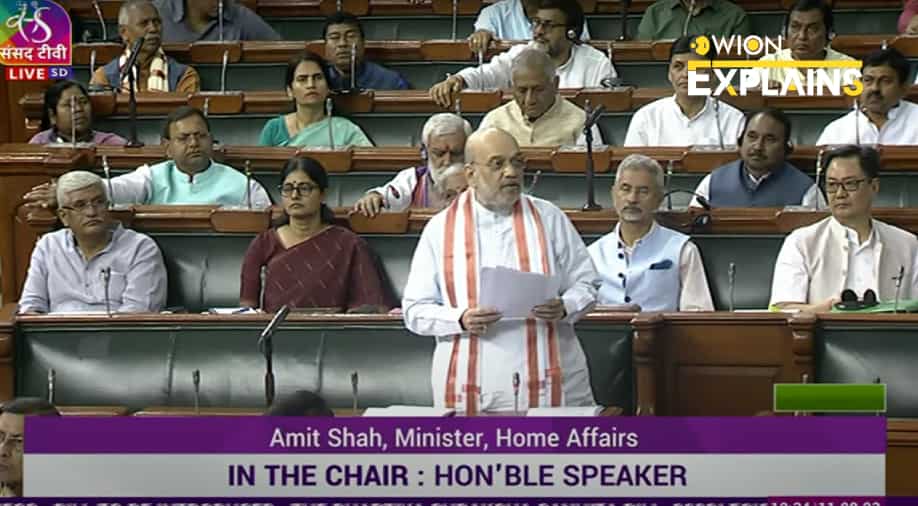
On the last day of the monsoon session of the parliament on Friday (Aug 11), Union Home Minister Amit Shah introduced three bills to repeal and replace the Indian Penal Code, the Code of Criminal Procedure, and the Indian Evidence Act.
The Bharatiya Nyaya Sanhita will replace The Indian Penal Code of 1860; the Bharatiya Nagarik Suraksha Sanhita will replace the Code of Criminal Procedure; and the Bharatiya Sakshya Bill will replace Indian Evidence Act.

While presenting the bills, Shah said that these changes are being brought to remove the references to the British monarchy and other "signs of slavery".
"These laws were made to strengthen the colonial rule, to protect colonial rulers, and the intention was to punish and not give justice," he said in the Lok Sabha (lower house).
"We are going to change this and the spirit of these new laws will be to protect the constitutional rights of our citizens," he added.
)
US vs China over South China Sea: Washington backs Philippines, Beijing hits back
)
Bigg Boss 20: Isha Rikhi evicted after three weeks in Salman Khan’s show
)
Musk plans to more than double xAI's chips to over 1.2 million Nvidia GPUs by year-end
)
After JU, clash erupts at SRFTI: BJP’s ‘Dimagi Naxal’ jibe sparks political firestorm after students protest RSS-linked event
)
‘Anti-social elements spreading false rumours’: LPU issues statement amid massive unrest over alleged rape
)
LPU students go on rampage, vandalise campus amid widespread protest: What's happening
)
Trump asked Xi to pressure Iran. China did not say yes — here’s what Beijing wants
)
US Treasury Secretary Scott Bessent hails global crackdown on Iranian banks and airlines
)
An OpenAI agent escaped its locked test cage again, by hiding questions in DNS lookups
)
'Our video was trimmed': LPU girls who featured in rape-denial video make U-turn
)
3 males killed, four others injured in shooting after fight at strip club in Detroit
)
'Victory for low-budget consumers': Raghav Chadha hails 30-day telecom recharge rules
)
Claude rebuilt the 1989 game 'Prince of Persia' by reusing the original's own code
)
Beyond metros: How Tier-2 and Tier-3 cities could drive India’s next AI wave
)
Tesla builds first Cybertruck with its own refined lithium: Elon Musk's $1 billion Texas bet pays off
)
IndiGo flight suffers tail strike in Bengaluru while landing; DGCA to probe incident
)
The US and China set up an AI 'red telephone', but skipped the rulebook
)
‘Terror suspects arrested near UK air base were looking to do big damage’: Trump
)
Russian envoy claims US tactics to contain India were revealed in ‘Freudian slip’
)
IND vs WI 1st ODI: Kohli breaks Sachin's most runs in one country record with unbeaten 139 as India thump West Indies by 8 wickets
)
Researchers rebuilt exactly how 700 AI agents hacked Hugging Face: a 900-link chain trick
)
‘Olympic inclusion is our major target’: WPA President Ishaun Singh on pool’s global ambitions
)
Nations League: Spain sink England at Wembley; Modric shines for Croatia
)
Why has Iran released no proof of life of Mojtaba Khamenei? Araghchi reveals...
)
'What kind of confession is this?': Pakistan PM Shehbaz Sharif’s 'terrorists would be roaming New York' remark goes viral, raises alarm online. Watch
)
South Korea demands apology from Ukraine over North Korean prisoners' transfer
)
Beyond BrahMos: India targets Rs 50,000 crore in defence exports with unmatched price edge
)
Sri Lankan Tamil migrant worker gets death sentence in Saudi Arabia, help sought from India
)
Muslim marriage cannot shield sex with minor wife from prosecution under POCSO: Delhi HC
)
'Can't help but draw painful parallels to Nirbhaya case': SC on latest incidents of rape cases in Delhi-NCR
)
99.9% more powerful - Scientists find boy who can recall memories from just 3 months of age
)
'FIRST LOOK from inside Noah’s Ark': Researchers share video from inside mysterious mound in Turkey
)
UNSC reform momentum grows: Russia, Portugal, Mauritius push for India's permanent seat bid
)
8 US marines injured in Iranian missile attack on vessel in Strait of Hormuz: Report
&im=FitAndFill=(700,400))
New OTT releases this week (September 28-October 4, 2026): Dupahiya 2, Pooja Meri Jaan, Ohh My Dog- 5 titles coming on Netflix, Prime Video and more
)
Afghanistan says 28 fighters killed in clash near Pakistan border, Islamabad denies
)
Ceuta migrant crisis: Protesters take to streets as Spain grapples with migrant challenge
)
LPU suspend classes, postpones exams as violence escalates over rape claims: What's happening
)
New York City wants a 'kill switch' on every AI, and will pay whistleblowers who report violations
The minister said that the new legislation "will aim to give justice, not punishment," and justified that the overhaul was imperative as the colonial laws have been at the core of the criminal justice system for over a century.
The legislation proposes 313 amendments that will bring revolutionary changes to the criminal justice system, Shah said.
The bills have been sent to a parliamentary standing committee for deliberations before passage.
Big revamp of Indian Criminal Laws
Capital punishment for mob lynching, 20 years for false marriage
The Bharatiya Nyaya Sanhita Bill, which is replacing the Indian Penal Code of 1860, prescribes capital punishment as the maximum sentence for mob lynching.
Furthermore, it would make sexual exploitation on the pretext of marriage, employment or promotion, or through the use of a hidden identity, a crime and suggests 10 years' imprisonment.
The bill, however, does not include forceful sexual intercourse by a man with his wife under rape.
It states that “sexual intercourse by a man with his own wife, the wife not being under eighteen years of age, is not rape.”
Community serviceadded as punishment for first time
For the first time, community service has been included as one of the punishments for petty offences.
The proposed law also states those evading arrest can be tried in their absence.
The police have to furnish an update on FIRs or First Information Reports within 90 days and an e-FIR can be lodged from anywhere.
The bill has mandated that search and challan (prosecution) process has to be videographed.
The proposed law also suggests one-year jail for bribing voters during elections.
Death sentence retained
Moreover, the bill states that it seeks to make offences more gender-neutral.
In order to deal effectively with the problem of organised crimes and terrorist activities, new offences of terrorist acts and organised crime have been added with deterrent punishments.
The fines and punishment for various offences have also been enhanced.
For gang rape, the punishment can be 20 years in jail to a life term.
The death sentence has been retained in the new bills.
Sedition law strengthened?
One of the most notable changes is the repeal of Section 124A of the Indian Penal Code (IPC)—the sedition charges—which will be replaced by a more encompassing law.
Section 150 of the Bharatiya Nyaya Sanhita (BNS) Bill, 2023, does not use the word sedition, rather it describes the offence as “endangering sovereignty, unity and integrity of India.”
It reads: “Whoever, purposely or knowingly, by words, either spoken or written, or by signs, or by visible representation, or by electronic communication or by use of financial mean, or otherwise, excites or attempts to excite, secession or armed rebellion or subversive activities, or encourages feelings of separatist activities or endangers sovereignty or unity and integrity of India; or indulges in or commits any such act shall be punished with imprisonment for life or with imprisonment which may extend to seven years and shall also be liable to fine.
Talking about the sedition charges proposed under the new bill, Shah said, “The bill for the first time defines terrorism and offences such as separatism, armed rebellion against the government, challenging the sovereignty of the country which were earlier mentioned under different provisions of law.”
He said that confiscation of property will be done on the orders of the court.
The current law on sedition
Section 124A of the IPC reads: Whoever, by words, either spoken or written, or by signs, or by visible representation, or otherwise, brings or attempts to bring into hatred or contempt, or excites or attempts to excite disaffection towards, the Government established by law in, shall be punished with imprisonment for life, to which fine may be added, or with imprisonment which may extend to three years, to which fine may be added, or with fine.”
Difference between new and old sedition laws
The key difference between the old and the new is that Section 150 has added “electronic communication” and “use of financial means” as tools of perpetuating an act “endangering sovereignty unity and integrity of India”.
The new provision also states that the category of offence under Section 150 will not be against “the Government established by law in India,” as mentioned under Section 124A of IPC.
Under this, the offence will kick-in when acts spark “secession or armed rebellion or subversive activities or encourages feelings of separatist activities or endangers sovereignty or unity and integrity of India.”
WATCH WION LIVE HERE